
Expert Data Recovery Solutions for Hard Disks and SSDs
The sudden failure of a critical storage device can halt operations and cause significant distress. For individuals and businesses across the United Kingdom, losing access to precious files, vital documents, or client information represents a serious event.
Specialist firms offer a crucial lifeline in these situations. They possess the technical skill and advanced tools needed to attempt information retrieval from a wide array of media.
This includes internal hard drives, modern solid-state drives (SSDs), external units, and even complex RAID configurations. Their work is often the last hope for recovering what seems permanently lost.
The process itself is highly specialised. It frequently requires a controlled laboratory environment and expert knowledge to navigate the intricacies of modern storage technology. A successful outcome is never guaranteed, but the right expertise maximises the chance.
This resource aims to demystify the field of data recovery. It outlines what one can expect when facing a storage crisis and explores the methodologies employed by leading UK centres.
Key Takeaways
- Storage device failure can have a devastating impact on both personal and commercial activities.
- Expert help is available for all media types, from traditional hard disks to sophisticated SSD arrays.
- The situation demands urgent attention, as delay can sometimes reduce the likelihood of a successful retrieval.
- Modern data recovery is a complex technical discipline requiring specific equipment and cleanroom facilities.
- Understanding the process and available options is the first step towards resolving a data loss incident.
- Choosing a provider with a proven track record and transparent evaluation process is essential.
Overview of Expert Data Recovery Solutions
The depth of knowledge possessed by leading UK firms forms the cornerstone of effective data retrieval. This expertise is built upon decades of collective experience.
Established organisations have operated successfully for over eighteen years. They have assisted thousands of clients during that time.
Service Expertise and Industry Experience
Accredited professionals form the core of every skilled team. Their specialised knowledge covers all storage device failures.
These experts are available around the clock. They apply proven methodologies to each unique case.
This long-term focus ensures they can tackle even the most complex situations. Their track record inspires confidence.
Trusted Recovery Partners Across the United Kingdom
Nationwide coverage means help is never far away. Strategic service centres are located across England, Scotland, Wales, and Northern Ireland.
This network provides accessible solutions for everyone. A local presence supports faster response times.
Clear communication throughout the process is a key priority. It distinguishes these specialist operations from generic IT support.
Top-tier engineering resources back every project. The commitment is to deliver outstanding results and peace of mind.
Understanding Data Loss in Hard Disks and SSDs
Data loss scenarios vary widely, from simple human error to catastrophic physical damage. Knowing what caused the problem helps anyone understand their specific situation and the potential solutions available.
Common Causes of Data Loss
Physical impact is a frequent culprit. Dropping a hard drive can misalign internal parts or damage its delicate read/write heads. This often leaves the unit completely unresponsive.
Mechanical failure inside a traditional drive is another common issue. Listen for clicking or grinding noises. These sounds usually mean the drive’s motor has seized or its read heads have crashed onto the platters.
Logical errors can make files inaccessible without any hardware fault. Improper shutdowns, power surges, or software conflicts corrupt the file system. Viruses can also cause this type of data loss.
Solid-state drives (SSDs) fail differently. They have no moving parts, so issues are often electronic. Controller chip failures, NAND memory degradation, or corrupted firmware can happen without warning.
Catastrophic events like water damage, fire, or electrical surges affect multiple storage devices. Complex systems, like RAID arrays or NAS units, add another layer. Failure here involves multiple drives and requires specialised knowledge to reconstruct the data.
Modern devices present unique hurdles. In newer M1 and M2 MacBooks, the SSD is soldered directly to the logic board. Standard recovery methods will not work on this type of device.
|
Failure Type |
Primary Device Affected |
Common Indicators |
Typical Root Cause |
|
Physical Impact |
Hard Drives & External Units |
No power, clicking, visible damage |
Drops, shocks, bending |
|
Mechanical Failure |
Traditional Hard Drive |
Loud clicking, grinding, not spinning |
Head crash, motor seizure, spindle damage |
|
Logical Corruption |
Any Storage Media |
Error messages, missing files, won’t boot |
Software faults, viruses, improper ejection |
|
SSD Controller Failure |
Solid-State Drive |
Drive not detected, freezing system |
Firmware bug, electronic component fault |
|
Complex Array Failure |
RAID/NAS Systems |
Multiple drives offline, system crash |
Multiple simultaneous drive failures, configuration loss |
Professional Data Recovery Services for Hard Drives and SSDs
Every data loss incident presents its own unique set of challenges and requirements. Leading UK providers offer a comprehensive suite of solutions designed to address this full spectrum. Their work supports both individual users and commercial clients.
Tailored Solutions for Unique Data Loss Scenarios
No two cases are identical. A specialist begins with a non-destructive evaluation to pinpoint the exact failure. This diagnostic phase is crucial.
It determines whether the issue is logical, mechanical, or electronic. The findings inform a custom strategy. This tailored approach maximises the chance of a successful outcome.
Flexible service options cater to different urgency levels. A standard turnaround suits most needs. An expedited process is available for more pressing situations.
For business-critical cases, around-the-clock emergency support can be initiated. This ensures help is available whenever it’s needed most.
Ensuring Minimal Downtime for Business Continuity
For companies, prolonged system inactivity is not an option. These specialists prioritise rapid diagnostics and clear communication. Realistic timelines are established from the outset.
The systematic process is designed for efficiency. It starts with a free consultation and evaluation. Clients then review a detailed quote and approve the work.
Following this, the actual recovery work begins in dedicated facilities. Retrieved files are securely returned on new external media. This end-to-end handling minimises operational disruption.
Expertise extends to complex enterprise storage, including servers and multi-drive arrays. The goal is always to restore access swiftly and completely, safeguarding continuity.
Advanced Recovery Techniques and Equipment
Behind every successful file restoration lies a suite of advanced hardware and specialised software. These tools allow engineers to perform intricate operations on damaged storage devices.
The goal is always to retrieve information without causing further harm. This demands both precision and deep technical knowledge.
Utilising Cutting-Edge Hardware and Software
Specialist hardware includes systems like the AceLab PC3000 and Deepspar DDI. These units enable low-level communication with a drive’s internal circuitry.
They can bypass damaged firmware or read directly from the memory chips. This is crucial when standard connections fail.
Advanced software tools complement this hardware. They help reconstruct corrupted file systems and extract files from partially functional media.
Operating these systems requires extensive training. Engineers must understand storage architectures and data structures intimately.
Precision Recovery with Pointfix Computers
A meticulous approach defines this high-level work. Each case begins with a detailed assessment to identify the exact failure mechanism.
Engineers then apply the most appropriate methodology. The team at Pointfix Computers exemplifies this precision, tailoring their strategy for each unique scenario.
Sophisticated techniques vary by media type. Magnetic hard drives, solid-state drives, and flash storage all need different approaches.
A key technique is creating a sector-by-sector image of a failing drive. This allows multiple recovery attempts without stressing the original, damaged media.
|
Equipment Type |
Primary Function |
Typical Application |
|
PC-3000 Systems |
Firmware repair & low-level access |
Failing hard drives with electronic faults |
|
Deepspar DDI |
Stabilising unstable drives for imaging |
Drives with mechanical wear or bad sectors |
|
Flash Recovery Tools |
Direct NAND memory chip reading |
SSDs, USB drives with controller failure |
|
Imaging Software |
Creating exact copies of damaged media |
All device types prior to any recovery work |
Handling RAID, Laptops, SSDs and External Drives
From enterprise servers to pocket-sized memory cards, the range of devices needing specialist care is vast. Leading UK firms offer comprehensive solutions for this entire ecosystem.
Their expertise ensures no type of media is beyond help. This covers complex systems and everyday portable gadgets alike.
Integrated Recovery Approaches for Multiple Device Types
Restoring a failed RAID array demands deep knowledge of various levels like 0, 1, 5, and 6. Engineers must reconstruct the array, often handling several failed drives at once. This is a specialised skill set distinct from single-drive work.
Laptop recovery covers all major brands and storage types. This includes modern machines with soldered SSDs, which present unique challenges. Techniques for solid-state drive retrieval differ greatly from mechanical methods.
External units and mobile phones are also in scope. Specialists handle interfaces from USB to Thunderbolt. They retrieve lost data from damaged Android and iPhone devices that won’t power on.
The approach is integrated. Experts might retrieve files from a failed laptop and transfer them to new storage. They understand connections between device types. This holistic view maximises success for all data loss situations.
Cleanroom Environment and Board-Level Recovery
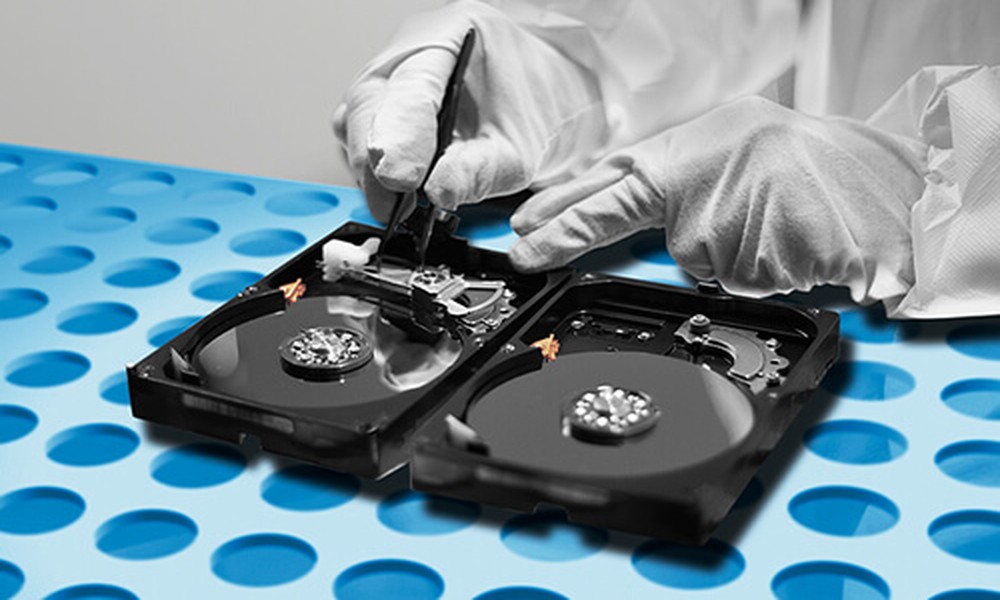
Contamination from a single speck of dust can permanently destroy the data on a hard disk‘s platters. This is why leading specialists perform internal work exclusively within certified cleanroom laboratories.
These controlled spaces are engineered to ISO Class 4 standards. They maintain an exceptionally low count of airborne particles.
Expert Techniques in Controlled Cleanroom Settings
The entire process, from initial assessment to final extraction, happens in this optimal environment. Engineers use precision tools to open a drive‘s sealed casing.
They can then inspect and replace delicate components like read/write heads. Every movement is calculated to prevent further harm to the fragile media.
Safe Handling of Failing Components
For a device with mechanical failure, parts are swapped using donor components. These must be an exact match to ensure compatibility.
Modern systems like Apple’s M-series MacBooks present a different challenge. Their storage is soldered directly to the logic board.
This demands board-level recovery, involving micro-soldering and circuit repair. Only after this is successful can the file retrieval process begin.
|
Cleanroom Class |
Max Particles per m³ |
Primary Use in Recovery |
Key Feature |
|
ISO 4 |
10,000 (0.1µm) |
Internal HDD work & head swaps |
Essential for platter exposure |
|
ISO 5 |
100,000 (0.1µm) |
PCB repair & external cleaning |
Used for less sensitive tasks |
|
ISO 6 |
1,000,000 (0.1µm) |
Device inspection & packaging |
General clean assembly area |
This meticulous approach in a pristine setting offers the highest probability of a successful outcome for any case. It turns a seemingly hopeless situation into a solvable one.
Customer Success Stories and Testimonials
Nothing speaks louder about technical capability than documented cases where precious information was brought back from the brink. These accounts demonstrate what specialist intervention can achieve.
They offer genuine hope to those facing similar crises. Client feedback highlights both technical excellence and compassionate service.
Real-Life Recovery Case Studies
One family recovered over 20 years of digital photographs from a crashed NAS drive. Another client got their critical business files back after a destructive fire.
A wedding photographer faced disaster when a memory card was reformatted. The complete image set was retrieved within hours, saving their professional reputation.
“They recovered 99.8% of my work from a failing drive with 10+ years of projects. Other firms said it was impossible. Their clear communication and fair pricing were exceptional.”
These success stories include water-damaged laptops and mechanically failed external drives. In many cases, over 90% of the data was successfully recovered.
Case Study: Pointfix
The work with Pointfix illustrates methodical precision. Their approach retrieved data back from severely damaged media that others had written off.
This collaboration shows how expert knowledge combines with advanced tools. The result is consistently high recovery rates for even the most challenging situations.
Clients frequently mention the profound relief they feel. Getting irreplaceable files or decades of memories data back creates lasting gratitude. This customer satisfaction is the ultimate measure of success.
Why Choose a Certified and Trusted Recovery Company
Selecting an accredited firm is about more than technical skill. It is a choice for peace of mind, built on transparent practices and a proven track record.
Exceptional Customer Service and No Recovery Fee Guarantee
The cornerstone of this trust is often a No Data, No Fee guarantee. This policy ensures you pay nothing if your information cannot be retrieved. It completely removes financial risk.
Established providers achieve success rates around 96%. They begin with a free, professional diagnostic assessment. This gives you a clear file list and a realistic quote before any work starts.
Expert guidance is available any day or night via phone. The entire process features regular updates and patient explanations. You receive a fixed price, approved upfront, with no hidden costs.
This combination of high success potential and outstanding customer service defines a truly trusted company.
Conclusion
When storage media fails, the path forward need not be one of despair. Comprehensive support is available across the United Kingdom for every type of device and failure scenario.
Lost information is rarely gone forever. Specialist teams possess the precise knowledge and advanced tools to retrieve files from seemingly hopeless situations.
Acting quickly is vital. Power down affected devices immediately and seek expert guidance. Avoid DIY attempts that risk causing permanent damage to your storage.
Accessing help is straightforward. Options include local drop-off, secure postal services, and remote assistance for logical issues. Emergency on-site response is also available for critical cases.
The retrieval process, while complex, is handled with clear communication by experienced professionals. They guide you through each step with patience and skill.
Do not delay. Contact a specialist today for a free assessment or quote. Their proven success rates and risk-free guarantees offer the best chance to restore your precious memories and vital business files.
FAQ
What should I do immediately after experiencing data loss?
Immediately power down the affected device to prevent further damage or data overwriting. Do not attempt DIY fixes or run recovery software, as this can complicate the situation. Contact a specialist firm like Pointfix Computers for a professional evaluation.
How long does the recovery process typically take?
Timescales vary based on the complexity of the case. Many standard recoveries are completed within a few business days. For more severe cases involving physical damage or complex RAID configurations, the process may take longer. The team will provide a clear timeline after their initial assessment.
Is it possible to retrieve information from a solid-state drive that has failed?
Yes, specialists can often recover data from failed SSDs. However, the process is highly technical and differs from traditional hard disk recovery. It requires advanced tools and expertise in flash memory technology, which certified labs possess.
What is your success rate for retrieving lost files?
A> While every case is unique, established providers typically achieve high success rates across thousands of cases. Their skilled team and advanced technology in a certified cleanroom environment maximise the chances of returning your valuable information.
Do you offer a ‘no data, no fee’ guarantee?
Reputable companies often provide a transparent ‘no recovery, no fee’ policy. This means if they are unsuccessful in retrieving your specified files, you do not pay for the attempt. Always confirm this guarantee before proceeding with any service.
Can you handle data loss from RAID arrays and servers?
A> Absolutely. Specialist firms have extensive experience with complex storage systems, including RAID 0, 5, 6, and 10 arrays, as well as server environments. They use integrated approaches to reconstruct arrays and recover data even from multiple simultaneous drive failures.
Why is a cleanroom necessary for some recoveries?
A ISO-certified cleanroom is essential for physically damaged drives. It provides a contaminant-free environment where technicians can safely open a hard disk’s sealed chamber without risk of dust causing further harm to the delicate platters and heads inside.
How is pricing determined for a recovery job?
Pricing is based on the specific requirements of your case, including the type of device, the cause of data loss, and the work required. You will receive a fixed, upfront quote after a diagnostic evaluation, with no hidden charges.